Smart home technology sounds futuristic until you realize that half the gadgets being advertised don't actually make your life easier.
A refrigerator that sends you notifications? Interesting.
A smart mirror that tells you the weather? Maybe.
A light that turns on automatically when you walk into a room? Now we're talking.
The best smart home gadgets aren't necessarily the most expensive or technologically impressive. They're the ones that solve a small everyday problem without creating another complicated system you have to manage.
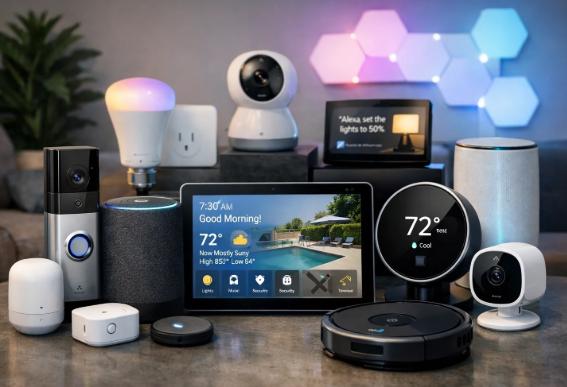
In 2026, useful smart-home categories include smart plugs, smart lighting, security cameras and doorbells, robot vacuums, and smart climate controls.
So before you turn your home into a showroom of gadgets you'll eventually stop using, here's what is actually worth considering.


1. Smart Plugs: The Easiest Upgrade


If you're buying your first smart-home gadget, start with a smart plug.
It's simple: plug it into a wall outlet, connect an appliance, and you can control that appliance using an app or compatible voice assistant.
They're particularly useful for lamps, fans, chargers, and other suitable appliances.
You can also create schedules.
For example, a lamp could turn on automatically in the evening and switch off at bedtime.
Some models also offer energy monitoring, which can help you understand how much electricity a connected device is using. (TechRadar)
TP-Link Tapo P110 16A Mini Smart Wi-Fi Plug
₹989
Worth buying? Absolutely.
They're relatively inexpensive and don't require you to replace the appliance itself.
2. Smart Bulbs: Small Change, Big Convenience


Smart bulbs are another easy entry point.
Instead of reaching for the wall switch, you can control compatible bulbs from your phone or through a voice assistant.
Depending on the model, you may be able to:
- Adjust brightness
- Change color temperature
- Create schedules
- Set scenes
- Turn lights off remotely
The real benefit isn't being able to say, "Turn on the lights."
It's automation.
Your bedroom lights can gradually turn on in the morning. Your living-room lights can switch on around sunset. Your outdoor lights can follow a schedule.
Philips Smart Wi-Fi LED Bulb B22 Wiz Connected
₹579
If you don't care about changing colors, don't pay extra just for RGB effects. A good dimmable white smart bulb may be all you need.
3. Robot Vacuums: The Luxury Gadget That Can Actually Save Time


This is probably one of the most useful smart-home upgrades for busy households.
Modern robot vacuums can do considerably more than randomly bump into furniture.
Higher-end models can map rooms, navigate around obstacles, vacuum, mop, and return to charging stations automatically. Some also include self-emptying docks. (Tom's Guide)
For homes that accumulate dust quickly, especially in urban environments, automated floor cleaning can be genuinely useful.
But don't assume the most expensive robot vacuum is automatically the best choice.
Think about your home first.
If you have a small apartment with very little floor space, a basic vacuum may be perfectly adequate.
If you have pets, children, lots of hard flooring, or a larger home, a more advanced robot may make much more sense.
Worth buying?
Yes—if it will replace a chore you regularly dislike doing.
4. Smart Security Cameras: Useful When You Actually Need Them


Smart cameras can provide an extra layer of visibility around your home.
Depending on the model, you may be able to check a live video feed, receive movement alerts, communicate through the camera, or review recorded footage.
Video doorbells can be particularly useful if you want to know who's at your door when you're away.
But there's an important consideration:
Privacy.
A camera is connected technology, so you should pay attention to account security, software updates, privacy controls, and where recordings are stored.
Use strong, unique passwords and enable two-factor authentication when available.
Don't buy a camera simply because it has dozens of AI features.
Buy one because you have a specific security problem you want it to solve.
5. Smart Speakers: Useful Beyond Playing Music


A smart speaker can become the central control point for your home.
You can use one to:
- Set timers
- Create reminders
- Play music
- Check information
- Control compatible lights
- Control compatible plugs
- Run routines
The important word here is compatible.
Before buying multiple smart devices, check that they work with the ecosystem you already use.
The goal is to create one connected system rather than five different apps that don't communicate with each other.
6. Smart Thermostats and Climate Controls


Climate control is another category where smart technology can be genuinely practical.
Depending on your home's existing heating or cooling setup, smart controls can let you adjust temperature remotely, create schedules, and automate certain routines.
This can be particularly useful if you're frequently away from home.
But compatibility is extremely important.
Not every smart thermostat or controller works with every heating and cooling system.
Before buying one, check your existing equipment and the manufacturer's compatibility requirements.
The best smart-home upgrade is useless if it doesn't work with the system you already have.
7. Smart Door Locks: Convenience With a Security Checklist


Smart locks can eliminate some of the small annoyances associated with traditional keys.
Depending on the model, you may be able to unlock the door using a code, phone, fingerprint, or other supported method.
Some systems can also provide temporary access codes for guests.
But because you're dealing with something that protects physical access to your home, don't choose based on appearance or convenience alone.
Look carefully at:
- Security features
- Backup entry methods
- Battery life
- Emergency access
- Compatibility
- Manufacturer support
A smart lock should make your home more convenient without making basic access unnecessarily complicated.
8. Smart Sensors: Tiny Gadgets With Surprisingly Big Uses
Sensors aren't as exciting as robot vacuums or smart displays, but they can be incredibly useful.
Motion sensors can trigger lights.
Door sensors can notify you when something opens.
Water-leak sensors can alert you to a possible leak.
Temperature or humidity sensors can help you monitor specific rooms.
These gadgets are particularly useful because they enable automation.
Instead of telling your smart home what to do every time, sensors can help the system respond automatically.
9. Don't Buy a Smart Version of Everything
Here's the most important rule:
You don't need a smart version of everything you own.
A smart kettle might sound impressive, but if you still have to physically fill it with water, press a button, and clean it, you've gained very little.
The same applies to many novelty gadgets.
Before buying anything, ask:
What problem does this solve?
If you can't answer that question clearly, don't buy it.
The best smart-home gadgets remove friction from things you already do.
10. Choose One Ecosystem and Keep It Simple


One of the fastest ways to make your smart home frustrating is buying devices from completely unrelated ecosystems.
Before purchasing, check:
- Which voice assistants it supports
- Whether it supports your preferred smart-home platform
- Whether it requires a separate hub
- Whether it supports Matter or other relevant standards
- Whether important features require a subscription
Compatibility matters more than having the biggest collection of gadgets.
A simple system where your lights, plugs, sensors, and other devices work together is much more useful than a house full of disconnected technology.
Smart Home Gadgets Worth Buying: Quick Ranking
If you're wondering where to spend your money first, here's a simple order:
1. Smart plugs — inexpensive and genuinely useful.
2. Smart bulbs or switches — excellent for lighting automation.
3. Robot vacuum — worthwhile if cleaning takes up a lot of your time.
4. Security camera or video doorbell — useful when you have a real security need.
5. Smart speaker — convenient as a control center.
6. Smart sensors — inexpensive additions that enable useful automation.
7. Smart climate controls — excellent when compatible with your home's system.
8. Smart locks — convenient, but worth researching carefully before buying.
Final Thought
A smart home doesn't need to look like something from a science-fiction movie.
The best setup is often surprisingly simple.
A few smart plugs can automate appliances. Smart lights can make everyday routines easier. A robot vacuum can take a recurring chore off your list. A camera can provide useful visibility when you're away.
The trick is to buy technology that solves an actual problem, rather than technology that simply looks impressive.
Start with one device.
Use it for a while.
Then ask yourself:
"Did this genuinely make my life easier?"
If the answer is yes, build from there.
If the answer is no, congratulations—you've just saved yourself from buying another gadget you'll eventually forget about. 🏠✨